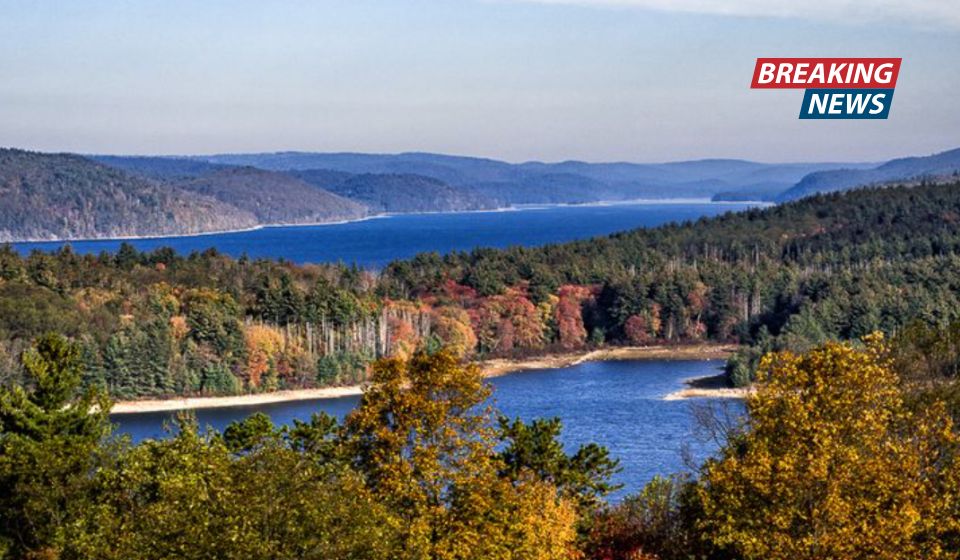
Four Massachusetts Towns Were Erased To Create This Massive 412-Billion-Gallon Reservoir.

The Quabbin Reservoir stands today as one of the most remarkable engineering projects in American history. Stretching across central Massachusetts and holding an astonishing 412 billion gallons of water, the reservoir supplies drinking water to millions of residents, including much of the Greater Boston area. Yet beneath its calm waters lies a forgotten landscape of homes, churches, schools, farms, roads, rail lines, and entire communities that were sacrificed to create it.
The story of the Quabbin Reservoir is not simply one of infrastructure and public works. It is also the story of four Massachusetts towns—Dana, Enfield, Greenwich, and Prescott—that were permanently erased from the map in the 1930s to meet the growing water needs of the state’s largest city. Decades later, the reservoir remains a vital source of clean water, while the memory of the lost towns continues to resonate with descendants and historians alike.
Why Massachusetts Needed a Massive New Water Supply
During the late nineteenth and early twentieth centuries, Boston experienced rapid population growth. Existing reservoirs and water systems that had once been adequate were struggling to keep pace with increasing demand. State officials began searching farther west for a reliable source of fresh water that could support the metropolitan region for generations.
Engineers eventually focused on the Swift River Valley in central Massachusetts. The valley possessed several qualities that made it ideal for a large reservoir. It featured a substantial watershed, relatively low population density compared to eastern Massachusetts, and terrain suitable for dam construction. After years of studies and planning, state lawmakers approved the project through legislation known as the Swift River Act in 1927.
The Selection of the Swift River Valley
The Swift River Valley was a thriving rural region composed of agricultural communities, local businesses, churches, schools, and family homesteads. Despite its suitability for a reservoir, the valley was home to approximately 2,500 residents who had deep roots in the area.
For state planners, the valley represented an opportunity to secure Boston’s future water supply. For local residents, however, it represented generations of history that would soon disappear forever.
The Four Towns That Were Sacrificed
The creation of the Quabbin Reservoir required the complete disincorporation and flooding of four Massachusetts towns.
Dana
Dana was located primarily in Worcester County and consisted of rural farms, homes, churches, and civic institutions. Although portions of the former town remain above water today, the community itself ceased to exist as a municipality in 1938. Some remnants, including stone foundations and cellar holes, can still be found in preserved historic areas.
Enfield
Enfield was the largest and most populous of the four towns. Established in the early nineteenth century, it served as a regional center within the Swift River Valley. Residents of Enfield watched as their homes, businesses, and public buildings were gradually removed before the valley was flooded.
One of the most famous moments in the town’s history occurred during the Farewell Ball held shortly before its official dissolution. Residents gathered one final time to commemorate the end of their community before it disappeared forever.
Greenwich
Greenwich was a picturesque farming community known for its rolling landscape and close-knit population. Like the other towns, it was ultimately condemned as part of the reservoir project. Most of the town now lies beneath the waters of the Quabbin.
Prescott
Prescott occupied the northwestern portion of the future reservoir basin. While part of the former town remains above water on what is now known as the Prescott Peninsula, the municipality itself was dissolved and largely abandoned to make way for the reservoir project.
The Forced Removal of Thousands of Residents
The reservoir project required more than just acquiring land. Entire communities had to be dismantled and relocated.
Approximately 2,500 people were forced to leave their homes. Many families had lived in the valley for generations and were deeply connected to the land. State authorities purchased large amounts of property, while some land was ultimately acquired through eminent domain.
Residents were compelled to move elsewhere, leaving behind schools, churches, businesses, farms, and lifelong memories. The emotional impact of the displacement remains a significant part of the reservoir’s legacy. Many descendants of former residents continue to speak about the loss of their heritage and hometowns.
The Official End of the Towns
At midnight on April 27, 1938, the towns of Dana, Enfield, Greenwich, and Prescott officially ceased to exist as incorporated municipalities. Their remaining land was later absorbed into neighboring communities.
For the residents who witnessed it, the date marked the formal end of communities that had existed for decades.
Demolishing an Entire Region
Before flooding could begin, the state undertook an enormous effort to clear the future reservoir basin.
More than a thousand buildings were either demolished or relocated. Homes, schools, barns, churches, and municipal buildings were dismantled. Some notable structures were moved intact to new locations throughout Massachusetts, preserving a small portion of the valley’s architectural history.
Roadways were abandoned, railroad lines removed, and vegetation cleared. Trees and brush throughout the future reservoir area were cut down or burned to ensure water quality once flooding began.
Moving Cemeteries and Graves
One of the most sensitive aspects of the project involved relocating cemeteries.
More than 7,000 graves were exhumed and transferred to new burial grounds, including Quabbin Park Cemetery in Ware. The process required extraordinary planning and remains one of the largest cemetery relocation efforts in New England history.
Families often attended reburial ceremonies as generations of relatives were moved from their original resting places before the waters arrived.
Building the Reservoir
Construction of the reservoir centered on two major engineering structures: Winsor Dam and Goodnough Dike. These massive barriers were built between 1930 and 1939 to contain the future reservoir waters.
Once the valley had been cleared and the structures completed, officials closed the diversion tunnel carrying the Swift River in August 1939. Water began accumulating behind the dam, slowly transforming the valley into a vast inland lake.
Seven Years to Reach Capacity
The filling process was gradual. Water levels rose year after year as former roads, fields, and town centers disappeared beneath the surface.
By 1946, the Quabbin Reservoir had reached its full capacity of approximately 412 billion gallons. At the time, it was considered the largest artificial drinking-water reservoir in the world. The finished reservoir covered roughly 39 square miles and featured approximately 181 miles of shoreline.
What Lies Beneath the Water Today
Although most visible traces of the four towns vanished long ago, remnants still exist beneath the reservoir.
Former roadbeds, foundations, railroad grades, and other structures remain submerged beneath the water. Some features have been documented through sonar surveys and limited authorized diving operations.
In a few locations above the waterline, visitors can still find stone walls, cellar holes, granite steps, and other remnants of the communities that once occupied the valley. These archaeological traces provide rare glimpses into the region’s lost past.
The Reservoir’s Importance Today
The Quabbin Reservoir remains one of the most important components of Massachusetts’ water infrastructure.
The reservoir serves as a primary source of drinking water for millions of people in Greater Boston and several communities in western Massachusetts. Water is transported through the Quabbin Aqueduct to the Wachusett Reservoir and then distributed through an extensive water supply network.
Because the surrounding watershed is carefully protected and largely undeveloped, the reservoir is considered one of the largest unfiltered drinking-water supplies in the United States. Its forests help maintain exceptional water quality while supporting a wide range of wildlife.
A Haven for Wildlife
Over the decades, the protected watershed has evolved into an important ecological sanctuary.
The forests surrounding the reservoir support populations of black bears, moose, deer, bobcats, coyotes, foxes, and numerous bird species, including bald eagles. Limited public access helps preserve both the ecosystem and the purity of the water supply.
The Legacy of the Lost Towns
The Quabbin Reservoir is often celebrated as an engineering achievement, but its history remains deeply intertwined with sacrifice and displacement.
For descendants of the former residents, the story is not simply about water management. It is about communities that disappeared so that a growing metropolitan region could thrive. Family homes, local traditions, churches, schools, and generations of memories were submerged beneath the reservoir’s waters.
Today, memorials, museums, historical societies, documentaries, and preserved sites help keep the memory of Dana, Enfield, Greenwich, and Prescott alive. Their story serves as a reminder that major public projects often come with profound human consequences.
Nearly a century after the towns were erased, the Quabbin Reservoir continues to provide life-sustaining water to millions, while beneath its surface rests one of the most extraordinary lost landscapes in American history.