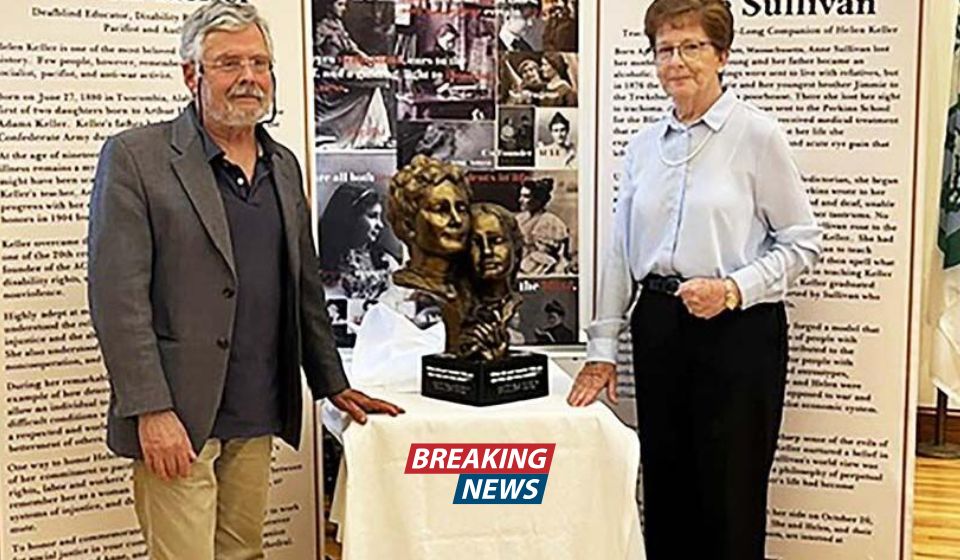
Historic Anne Sullivan and Helen Keller statue unveiled to Tewksbury

The Town of Tewksbury, Massachusetts, has long been associated with one of the most inspiring stories in American history—the remarkable relationship between Anne Sullivan and Helen Keller. The unveiling and continued recognition of a historic statue honoring the pair serves as a tribute to their extraordinary achievements and the enduring impact they have had on education, disability rights, and human perseverance. The monument stands as a powerful reminder of the bond between teacher and student that transformed both their lives and inspired generations around the world.
The sculpture, known as “Water,” depicts the famous moment when Anne Sullivan helped Helen Keller understand language through the spelling of the word “water” into her hand. This breakthrough became one of the most celebrated moments in educational history and marked the beginning of Keller’s journey toward communication and advocacy.
The Deep Connection Between Tewksbury and Anne Sullivan
Anne Sullivan’s Early Life in Tewksbury
Anne Sullivan’s connection to Tewksbury dates back to her childhood. Born in 1866, Sullivan experienced significant hardship early in life. Following the death of her mother and the struggles of her family, she and her brother were sent to the Tewksbury Almshouse, a public institution that cared for the poor and disadvantaged.
Despite facing poverty and severe vision problems, Sullivan’s determination eventually led her to attend the Perkins School for the Blind in Boston. There, she received the education that would later enable her to become one of the most influential teachers in history. Tewksbury therefore represents not only a place of hardship but also the beginning of a journey that would ultimately change the world.
A Community Proud of Its History
Because of Sullivan’s roots in the town, Tewksbury has embraced her legacy through educational programs, memorials, and public recognition. Residents have long viewed her story as one of perseverance, resilience, and compassion. The statue honoring Sullivan and Keller reflects the community’s commitment to preserving this important chapter of local and national history.
The Statue and Its Meaning
The Famous “Water” Moment Captured in Bronze
The sculpture titled “Water” was created by renowned sculptor Mico Kaufman in 1985. It depicts Anne Sullivan and Helen Keller seated together as Sullivan spells the word “water” into Keller’s hand. The scene represents the life-changing breakthrough that allowed Keller to connect words with objects and concepts, opening the door to language and learning.
The artwork portrays Sullivan using her left hand to form the sign for “water” in Keller’s hand while Keller experiences the realization that would forever alter her life. The emotional power of this moment has made it one of the most recognizable scenes in the history of special education.
Design and Materials
The monument is a bronze sculpture mounted on a polished granite base. The base bears the inscription identifying the two historical figures and references the title “Water.” The rough bronze finish was intentionally chosen to emphasize realism and emotional expression. According to records maintained by the Smithsonian Institution, the sculpture is located near Tewksbury Town Hall.
Commemorating Tewksbury’s Heritage
The sculpture was presented as a gift from local citizens to commemorate the 250th anniversary of Tewksbury’s incorporation. Community leaders and residents viewed the monument as a fitting tribute to Anne Sullivan’s connection to the town and to the inspirational relationship she shared with Helen Keller.
Helen Keller’s Extraordinary Journey
Overcoming Deafness and Blindness
Helen Keller was born in Tuscumbia, Alabama, on June 27, 1880. Before reaching her second birthday, an illness left her deaf and blind. Unable to communicate effectively, Keller experienced years of frustration and isolation until Anne Sullivan entered her life in 1887.
Sullivan’s innovative teaching methods helped Keller develop language skills through tactile communication. The famous water-pump lesson became the turning point that enabled Keller to understand that words represented objects and ideas.
Becoming a Global Advocate
After mastering communication, Keller achieved milestones that many thought impossible. She became the first deaf-blind person to earn a bachelor’s degree and later emerged as an internationally recognized author, lecturer, and advocate. Throughout her life, she championed the rights of people with disabilities, women, workers, and disadvantaged communities.
Her accomplishments transformed public perceptions of disability and demonstrated the potential that can be unlocked through education, opportunity, and support.
Anne Sullivan’s Lasting Influence
More Than a Teacher
While Helen Keller became world famous, Anne Sullivan’s role was equally extraordinary. Sullivan devoted decades of her life to teaching, guiding, and supporting Keller. Their partnership extended far beyond the classroom and evolved into one of the most celebrated relationships in educational history.
Sullivan’s methods broke new ground in teaching individuals with disabilities. Her patience, creativity, and belief in Keller’s abilities allowed her student to achieve what many experts of the era considered impossible.
An Inspiration for Educators
Educators continue to study Sullivan’s techniques and dedication. Her story remains a powerful example of how a committed teacher can change the course of a student’s life. The statue in Tewksbury honors not only Sullivan’s accomplishments but also the broader importance of education and mentorship.
Public Recognition of Keller and Sullivan’s Legacy
National and International Honors
The influence of Helen Keller and Anne Sullivan has been recognized through numerous memorials, monuments, books, films, and educational programs. In 2009, Alabama donated a statue of Helen Keller to the United States Capitol’s National Statuary Hall Collection. The monument depicts the young Keller at the moment she understood the meaning of water, becoming the first statue of a person with a disability and the first statue of a child permanently displayed in the Capitol.
More recently, additional monuments honoring Keller have been unveiled in Alabama, reflecting her continuing importance as a symbol of courage and perseverance.
Continuing Educational Efforts
Organizations across the country continue to celebrate the story of Sullivan and Keller through exhibitions, educational programs, and traveling displays. These initiatives help new generations understand the significance of their achievements and the lessons their lives offer about inclusion, determination, and opportunity.
Why the Tewksbury Statue Matters Today
The historic Anne Sullivan and Helen Keller statue in Tewksbury remains far more than a piece of public art. It symbolizes the transformative power of education, the importance of perseverance in the face of adversity, and the profound impact one individual can have on another’s life.
For visitors, students, educators, and residents alike, the monument serves as a reminder that extraordinary accomplishments often begin with a single breakthrough and a teacher willing to believe in a student’s potential. Through the story captured in bronze, Tewksbury continues to honor two remarkable women whose legacy has transcended generations and continues to inspire people around the world.