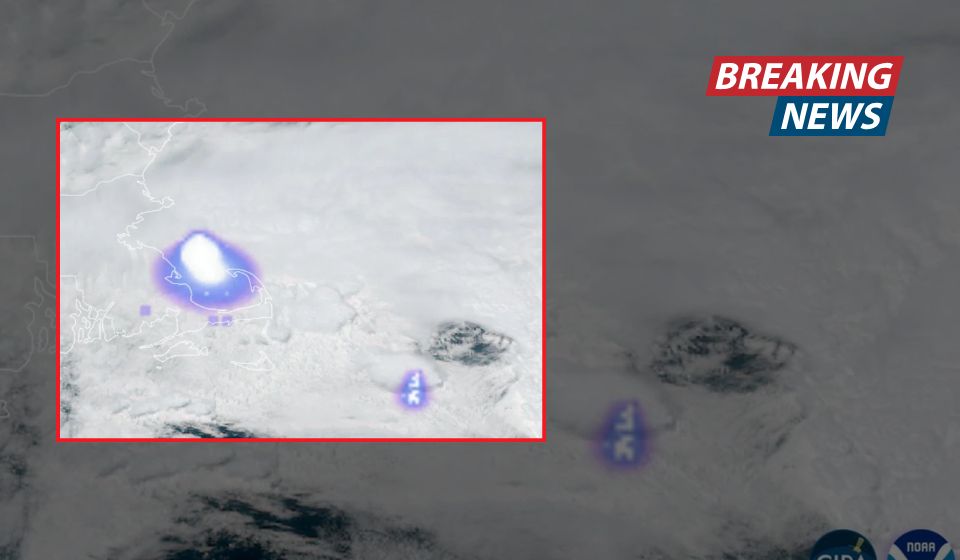
Massive Boom Shakes Massachusetts Coast as Meteor Explodes Over Atlantic

Residents across Massachusetts and parts of the Northeast were left stunned after a powerful boom echoed across the region, rattling windows, startling pets, and prompting countless calls to local authorities. What many initially feared might have been an earthquake, an explosion, or even military activity turned out to be something far more extraordinary—a meteor exploding high above the Atlantic Ocean.
The rare celestial event unfolded during the afternoon hours, creating a brilliant fireball in the sky and generating a shock wave strong enough to be heard across multiple states. Scientists later confirmed that a sizable meteor entered Earth’s atmosphere at tremendous speed before breaking apart over waters near the Massachusetts coastline.
The event quickly became one of the most talked-about astronomical incidents of the year, captivating both residents and researchers alike.
Loud Boom Sparks Widespread Confusion
The mystery began shortly after 2 p.m. when people throughout Massachusetts reported hearing an intense, sudden boom.
Residents described the sound as:
- A powerful explosion
- A thunder-like blast on a clear day
- A shock wave that rattled windows
- A noise strong enough to shake homes
- An event that frightened pets and startled families
Reports flooded local news stations, emergency dispatch centers, and social media platforms.
People from coastal communities, suburban neighborhoods, and even areas hundreds of miles apart reported experiencing the same unusual sound.
Because no storms were present and no immediate explanation was available, speculation spread rapidly.
Some believed an earthquake had occurred, while others wondered whether a military aircraft or industrial accident was responsible.
Scientists soon discovered the real cause was far more fascinating.
Fireball Streaks Across the Afternoon Sky
As reports of the boom continued to emerge, eyewitnesses began sharing accounts of a bright object moving across the sky moments before the sound was heard.
Dozens of observers reported seeing a glowing fireball racing through the atmosphere.
Sightings came from multiple locations across New England and neighboring states, helping researchers reconstruct the object’s path.
Astronomers classify these exceptionally bright meteors as bolides or fireballs because of the intense light they produce as they burn through Earth’s atmosphere.
Unlike ordinary shooting stars, which often go unnoticed, fireballs are bright enough to attract widespread attention and can sometimes be visible even during daylight hours.
The Massachusetts event was one of those rare daytime fireballs.
NASA Reveals the Meteor’s Incredible Size and Speed
Scientists later analyzed the event and determined that the meteor was significantly larger than the tiny space particles that enter Earth’s atmosphere every day.
According to researchers, the object measured roughly five feet in diameter and weighed several metric tons before entering the atmosphere.
The meteor reportedly traveled at an astonishing speed of approximately 42,000 miles per hour.
To put that into perspective, that speed is:
- More than 50 times faster than a commercial airliner
- Faster than most bullets
- Capable of circling the Earth in less than an hour
As the space rock plunged toward Earth, intense friction with atmospheric gases caused its surface to heat dramatically.
The result was a brilliant fireball visible across a wide geographic area.
Why the Explosion Was So Powerful
Many people were surprised to learn that a meteor exploding dozens of miles above the Earth’s surface could produce such a loud noise.
The explanation lies in the incredible speed at which meteors travel.
When a large object enters the atmosphere at hypersonic speeds, it compresses air in front of it.
This creates powerful pressure waves similar to those produced by supersonic aircraft.
As the meteor slows, heats up, and eventually breaks apart, those pressure waves spread outward.
When the waves reach the ground, people hear what is commonly known as a sonic boom.
In some cases, the sound can travel dozens or even hundreds of miles from the meteor’s actual flight path.
That is why residents across such a large area reported hearing the same explosive noise.
Energy Release Equivalent to Hundreds of Tons of TNT
One of the most remarkable findings involved the amount of energy released during the breakup.
Scientists estimated that the meteor explosion produced energy equivalent to approximately 230 tons of TNT.
While far smaller than catastrophic asteroid impacts portrayed in movies, the event still represented a significant atmospheric explosion.
The tremendous energy release explains why:
- Windows vibrated
- Homes shook slightly
- Pets became alarmed
- Residents reported feeling pressure waves
Fortunately, the explosion occurred high in the atmosphere and over water, preventing any danger to populated areas.
Meteor Breaks Apart Above the Atlantic
Researchers determined that the meteor traveled for approximately 26 miles through the atmosphere before breaking apart.
The fragmentation occurred at an altitude of roughly 31 miles above Earth’s surface.
As the object disintegrated, fragments continued toward the ocean.
Scientists believe pieces of the meteor ultimately fell into waters near Cape Cod Bay.
Because the impact area was offshore, recovering fragments may prove difficult.
However, researchers say valuable scientific information can still be gathered even if physical pieces are never found.
Could Meteor Fragments Be Recovered?
Whenever a meteor survives atmospheric entry, scientists become eager to recover any remaining fragments.
Meteorites provide unique insights into the formation of the solar system and often contain materials older than Earth itself.
However, ocean impacts present major challenges.
Most of Earth’s surface is covered by water, making ocean landings far more common than many people realize.
In this case, experts believe the fragments likely landed in relatively deep water.
Recovering small meteorite pieces from the seafloor would require significant resources and may not be practical.
Still, researchers can learn a great deal from eyewitness accounts, videos, radar observations, and satellite data.
Why Meteorites Fascinate Scientists
Meteorites are often described as natural time capsules.
Unlike Earth rocks that have undergone billions of years of geological change, many meteorites preserve material dating back to the birth of the solar system.
Scientists study them to learn about:
- Planet formation
- Asteroid composition
- Early solar system history
- Cosmic collisions
- Organic molecules in space
Every recovered meteorite has the potential to reveal new information about the origins of planets and the building blocks of life.
This is one reason why even relatively small meteor events generate excitement within the scientific community.
Are Meteor Explosions Dangerous?
Although the Massachusetts event produced an impressive boom, experts stress that such incidents rarely pose a threat to people on the ground.
Earth’s atmosphere acts as a protective shield.
Every day, countless small meteoroids enter the atmosphere and burn up harmlessly.
Only a small percentage survive long enough to produce visible fireballs.
Even fewer create sonic booms or scatter meteorites.
The chances of a person being directly struck by a meteorite are extraordinarily low.
Scientists often note that the risk is so small that most people will never encounter a meteorite during their lifetime.
Part of a Growing Number of Fireball Reports
The Massachusetts meteor is one of several notable fireball events reported across North America in recent months.
Astronomers and meteor tracking organizations have documented multiple bright fireballs and sonic boom-producing meteors throughout 2026.
These events have occurred over:
- Ohio
- Texas
- The southeastern United States
- Various regions of Canada
Researchers emphasize that the apparent increase does not necessarily indicate any unusual threat to Earth.
Instead, improvements in technology, camera networks, satellite monitoring, and public reporting systems have made meteor detection easier than ever before.
As a result, more events are being documented and studied.
How Scientists Tracked the Meteor
Modern meteor investigations rely on a combination of technologies.
Researchers used:
- Satellite observations
- Atmospheric monitoring systems
- Eyewitness reports
- Video recordings
- Radar data
- Lightning detection networks
Together, these sources allowed scientists to reconstruct the meteor’s trajectory and estimate its size, speed, and explosion energy.
The ability to analyze such events in near real-time represents a major advancement in planetary science.
Final Thoughts
The meteor explosion off the Massachusetts coast transformed an ordinary afternoon into an unforgettable scientific event. What began as a mysterious boom heard across New England was ultimately traced to a fast-moving space rock that entered Earth’s atmosphere, blazed across the sky as a brilliant fireball, and exploded with the force of hundreds of tons of TNT.
While the event startled residents and generated widespread curiosity, experts emphasize that it posed no threat to the public. Instead, it provided a rare opportunity to witness one of nature’s most spectacular cosmic phenomena. As scientists continue studying the data collected from the explosion, the Massachusetts meteor will likely remain one of the most memorable astronomical events of 2026.